Wharton's Jelly Stem Cells
vs
Your Own Body's Stem Cells
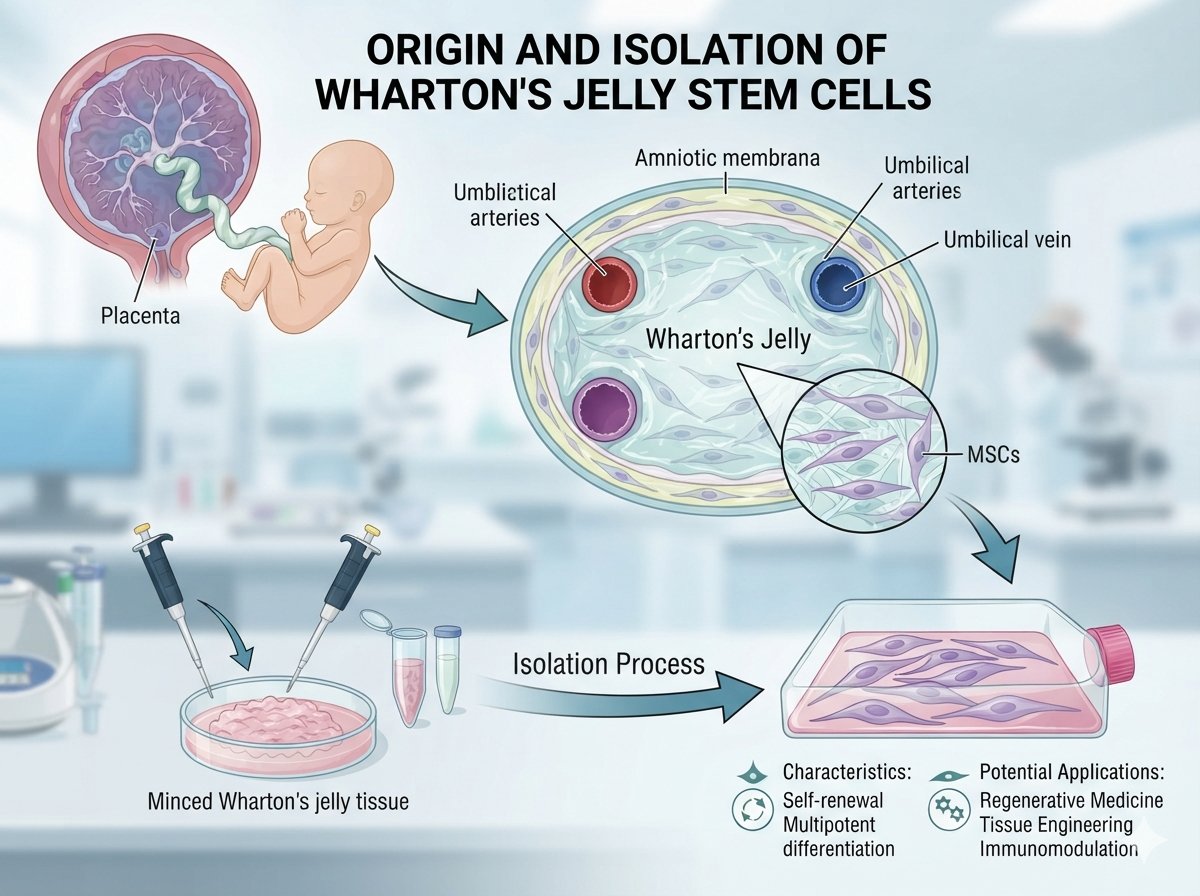
If you’ve been researching regenerative medicine for knee pain, arthritis, or another orthopedic concern, you may have encountered advertisements for Wharton’s jelly stem cells. You may also have heard about treatments that use stem cells obtained from your own body. While these approaches are sometimes discussed as though they are interchangeable, there are important differences patients should understand.
Wharton’s jelly comes from the umbilical cord, meaning products derived from it originate from donor tissue. At Kansas Regenerative Medicine Center (KRMC), our approach is different: we use adult mesenchymal cells obtained from the patient’s own body, rather than Wharton’s jelly or embryonic stem cells.
Understanding that distinction—and what current research and FDA information actually say—can help you ask better questions when exploring regenerative medicine.
Learn more about KRMC’s approach to stem cell therapy.
What Are Wharton’s Jelly Stem Cells?
Wharton’s jelly is the gelatinous connective tissue surrounding the blood vessels inside an umbilical cord. This tissue has attracted significant research interest because it can be a source of mesenchymal stromal/stem cells, commonly abbreviated as WJ-MSCs.
Research has found that Wharton’s jelly-derived MSCs possess characteristics such as substantial proliferative capacity and multipotency. At the same time, researchers have cautioned that clinical studies historically have been relatively small and that additional rigorous clinical trials are needed to establish safety and effectiveness for various applications.
There is another important distinction:
Wharton’s jelly cells are not your cells. When Wharton’s jelly is obtained from donated umbilical-cord tissue and subsequently used in another individual, it is considered an allogeneic source.
Cells or tissues obtained from your own body and used in you are described as autologous.
Are Wharton’s Jelly Stem Cells the Same as Umbilical Cord Blood Stem Cells?
No—and this distinction is especially important.
Wharton’s jelly is connective tissue surrounding the vessels of the umbilical cord. Umbilical cord blood, meanwhile, is the blood remaining in the cord and placenta following birth.
This matters when patients encounter phrases such as “FDA-approved cord stem cells.”
According to the FDA, the only stem-cell products currently FDA-approved in the United States consist of blood-forming (hematopoietic) stem cells derived from umbilical cord blood, and those products are approved for disorders involving the blood-forming system. They are not approved for orthopedic conditions such as osteoarthritis or knee, hip, shoulder, or back pain.
In other words, an FDA-approved cord-blood product for certain blood disorders should not be confused with a Wharton’s jelly product marketed for joint problems.
That is an important question to ask any regenerative medicine provider.
What Is the Difference Between Wharton’s Jelly Stem Cells and Your Own Stem Cells?
The simplest difference is where the cells originate.
At KRMC, adult mesenchymal cells can be collected from a patient’s own naturally occurring tissue. This is different from receiving cells or tissue originating from a donor umbilical cord.
Comparison | WHARTON'S JELLY | KRMC's autologous approach |
|---|---|---|
Source | Umbilical-cord tissue | Patient's own body |
Donor | Another individual | You |
Classification | Allogeneic | Autologous |
Requires Patient Harvesting? | No | Yes |
Research interest | Significant and evolving | Significant and evolving |
Orthopedic FDA Status | Not FDA approved for orthopedic conditions | Autologous regenerative interventions also require careful consideration of applicable FDA regulation |
KRMC uses it? | No | Yes-KRMC uses patient's own cells |
FDA guidance is important here because the agency specifically advises consumers to understand whether a regenerative medicine product comes from their own cells/tissue (autologous) or another person's cells/tissue (allogeneic).
Why Does KRMC Use Stem Cells From Your Own Fat?
Your own body's tissue is an accessible source of adult mesenchymal/stromal cells and has been extensively investigated in regenerative medicine.
At Kansas Regenerative Medicine Center, physicians collect cells from the patient's own tissue through a minimally invasive procedure. The cells used in KRMC's procedures therefore originate from your own body—not an embryo, umbilical cord, or unrelated donor.
Explore how stem cell therapy works at Kansas Regenerative Medicine Center.
For many patients, understanding the source of the cells is an important part of making an informed decision. Questions worth asking a provider include:
- Where do the cells or tissue come from?
- Are they mine or from a donor?
- How are they collected?
- How are they processed?
- What exactly is being injected?
- What evidence supports using this particular product for my condition?
- Is the proposed use FDA-approved?
- If it isn't FDA-approved, what regulatory pathway or clinical protocol applies?
- What are the potential risks and realistic benefits?
Those questions are far more useful than simply asking, “Which stem cells are best?”
What Does the Research Say About Wharton's Jelly Stem Cells for Knee Osteoarthritis?
There is legitimate scientific interest in WJ-MSCs, including for orthopedic applications. But promising research should not be confused with established clinical proof.
A systematic review published in 2025 examined clinical studies involving intra-articular Wharton’s jelly-derived MSCs for knee osteoarthritis and cartilage injury. Researchers identified only six eligible studies involving 97 patients and 134 knees. Functional measures improved in those studies and no serious adverse effects were reported, but radiological findings were mixed.
This is a good example of why nuance matters. The research is interesting and deserves continued study—but 97 patients across six qualifying studies is not the same thing as definitive evidence establishing a therapy as standard treatment.
A 2024 review similarly described WJ-MSCs as an area of potential interest for cartilage regeneration and osteoarthritis while discussing ongoing research into tissue-engineering techniques and future clinical applications.
What Does Research Say About Adult Stem Cells From Fat and Bone Marrow?
Autologous adult cells have also been extensively investigated.
A 2025 systematic review and meta-analysis examined randomized and comparative studies of cells for knee osteoarthritis. It included 10 studies and 563 cases. The analysis found improvements favoring MSC interventions for pain at assessed time points, while noting that these differences did not translate into substantial improvements in knee functionality.
That distinction is important. Responsible regenerative medicine education should discuss both promising findings and limitations, rather than promising that an injection will rebuild a joint or eliminate pain.
Read how KRMC patients have described their experiences with regenerative medicine.
Are Wharton’s Jelly Stem Cells FDA Approved for Arthritis or Joint Pain?
This is one of the most important questions someone searching for Wharton’s jelly stem cell therapy should investigate. The simple answer is no.
The FDA's consumer information states that regenerative medicine products including Wharton’s jelly have not been approved for orthopedic conditions, including osteoarthritis, tendonitis, disc disease, tennis elbow, and pain involving the knee, hip, shoulder, neck, or back.
The FDA has also warned consumers about regenerative medicine products marketed without the necessary approval and notes potential risks involving contamination, infection, immune reactions and other adverse outcomes.
This regulatory landscape remains active. In May 2026, for example, FDA issued a warning letter concerning a company marketing products associated with Wharton’s jelly-derived MSCs and umbilical-cord blood.
For current regulatory information, patients can review the FDA's consumer information on regenerative medicine products.
Does “Young Stem Cells” Automatically Mean Better Stem Cells?
Not necessarily.
One common marketing argument surrounding Wharton’s jelly stem cells is that cells originating from birth tissue are “younger,” so they must automatically provide better clinical outcomes than a patient's own adult stem cells.
That conclusion is too simplistic.
Laboratory characteristics such as proliferation, differentiation potential, cell viability and signaling behavior are scientifically interesting, but laboratory advantages do not automatically establish superior clinical outcomes in patients.
Research has reported favorable proliferative characteristics for Wharton’s jelly-derived MSCs compared with some adult MSC sources. Yet the same scientific literature has emphasized the need for rigorous clinical studies to determine safety and effectiveness.
So, when you see an advertisement emphasizing millions of “young” cells, consider asking:
- Does the provider have high-quality clinical evidence showing that this particular product produces better outcomes for my particular condition?
That is a much more meaningful question.
Why Does the Source of Stem Cells Matter?
The phrase “stem cell therapy” can describe very different things.
Two clinics may both advertise regenerative medicine while using fundamentally different sources, preparation methods, protocols and products.
That's why KRMC encourages patients to understand exactly what they are receiving.
KRMC's approach centers on adult mesenchymal cells obtained from the patient's own body. KRMC does not use Wharton’s jelly as the source for its stem-cell procedures.
Learn more about KRMC and our regenerative medicine approach.
What Should You Ask Before Choosing a Stem Cell Clinic?
Regenerative medicine can be confusing, particularly when websites use scientific terminology without explaining what it means.
Because of this, it is wise to consider the following questions before making a decision.
Consider asking the clinic:
- What is the exact source of the cells?
- Are they autologous or allogeneic?
- Is this treatment FDA-approved for my condition?
- What research supports the treatment?
- What risks are associated with it?
- Who processes the cells or tissue?
- What results should I realistically expect?
- How many patients with my particlular condition have you treated?
- How will my progress be monitored?
- What happens if I don't respond to treatment?
A reputable conversation should include potential limitations as well as potential benefits.
Wharton’s Jelly vs. Your Own Stem Cells: Is One Better?
There isn't a scientifically responsible one-word answer for every patient, condition and application.
Wharton’s jelly-derived MSCs remain an active area of scientific research, and published studies have produced findings worthy of continued investigation. However, research interest is different from FDA approval, and early clinical findings shouldn't be converted into promises of guaranteed results.
At Kansas Regenerative Medicine Center, our approach is centered on using the patient's own adult cells rather than Wharton’s jelly-derived donor cells.
For patients researching regenerative medicine, the takeaway is simple:
Don't just ask how many stem cells you're getting. Ask where they came from, what evidence supports their use, how they're processed, and why that particular approach is being recommended for you.
That conversation can tell you much more than a marketing claim.
Wharton’s jelly is connective tissue found within the human umbilical cord. It contains mesenchymal stromal/stem cells that have attracted substantial interest in laboratory and clinical research. When these cells originate from donated cord tissue and are administered to another individual, they are an allogeneic source.
No. Wharton’s jelly comes from umbilical-cord tissue, not embryos. However, they also aren't the patient's own cells when the tissue comes from a donor.
No. The FDA states that regenerative medicine products including Wharton’s jelly are not approved for orthopedic conditions such as osteoarthritis or knee pain.
No. Wharton’s jelly is connective tissue within the umbilical cord, while cord blood is blood collected from the cord and placenta. This distinction is particularly important because FDA-approved hematopoietic stem-cell products derived from cord blood have specific uses involving disorders of the blood-forming system; that approval does not mean Wharton’s jelly is FDA-approved for orthopedic treatment.
No. Kansas Regenerative Medicine Center's stem-cell approach uses adult cells obtained from the patient's own body, rather than Wharton’s jelly.
Adipose tissue is a well-established source of mesenchymal stromal/stem cells and has been widely studied in regenerative medicine. KRMC obtains cells used in its adipose-based procedures from the patient's own body.
No. Individual responses to regenerative procedures vary, and no responsible provider should promise a cure or guaranteed outcome. A medical evaluation is necessary to determine whether someone may be an appropriate candidate and to discuss potential benefits, limitations and risks.
Learn Whether You May Be a Candidate for Regenerative Medicine
If chronic knee, hip, shoulder or other joint discomfort is limiting the things you enjoy, understanding your options starts with good information.
At Kansas Regenerative Medicine Center, our approach uses adult stem cells obtained from the patient's own body. Our team can help you understand the procedure, discuss realistic expectations and determine whether you may be a candidate.
Call 844-320-4700 or visit kansasrmc.com to learn more.
KRMC serves patients through its locations in Manhattan and the Kansas City area.
*Regenerative medicine procedures are not guaranteed to produce a particular outcome. Information in this article is educational and should not be considered individual medical advice.*